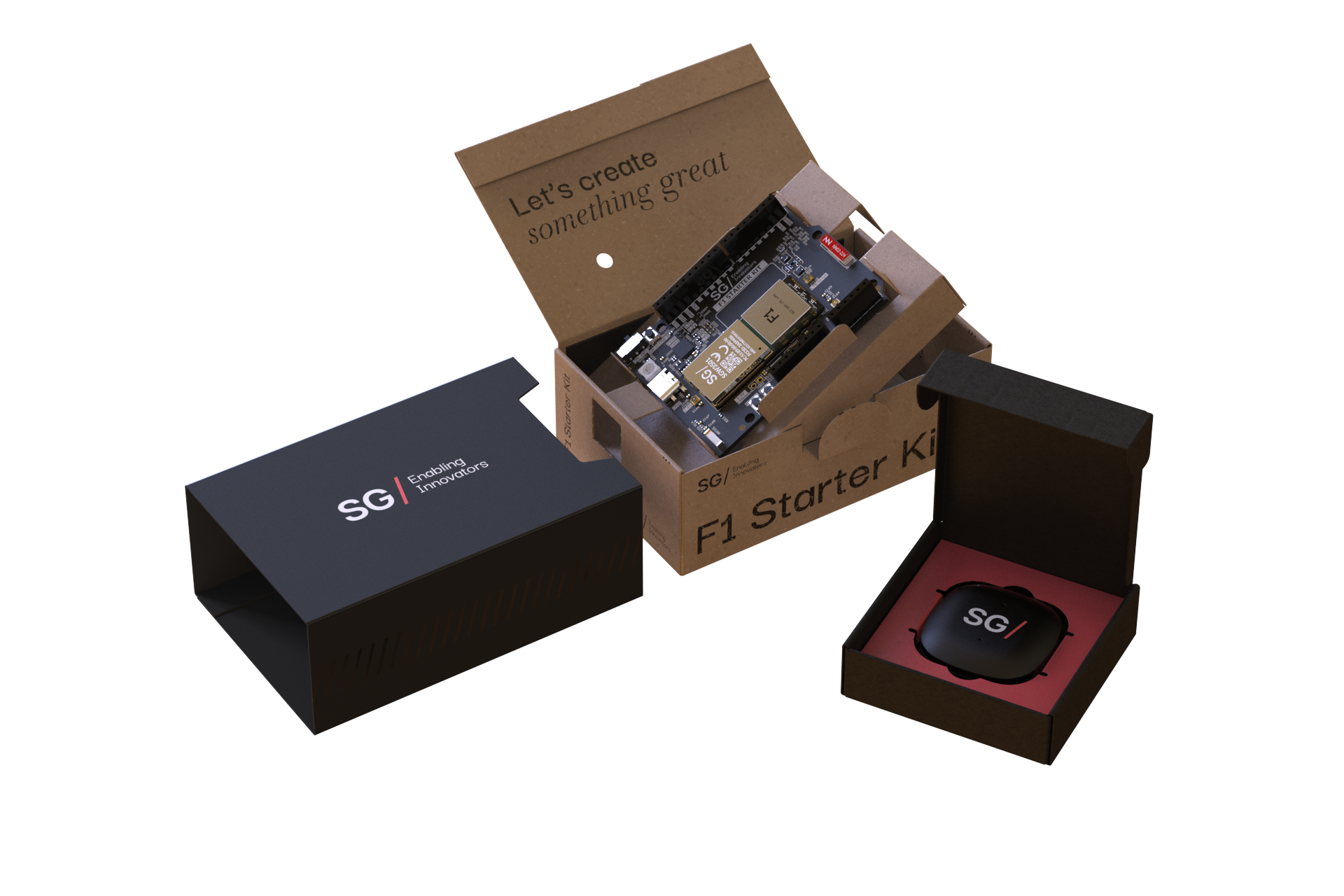

F1 Starter Kit

Evaluation board and development platform for the F1 Smart Module.

Plug in, code up, ship out.

Global SIM card and USB-C connectivity. MicroPython programmable. Comprehensive I/O expansion.

🚀 Multi-network Ready

  • Native support for four connectivity protocols: LTE Cat-M1/NB, LoRaWAN, Wi-Fi, and Bluetooth LE
  • Single board integration eliminates additional hardware complexity
  • Immediate testing of F1 Smart Module‘s multi-connectivity features
  • Native support for four connectivity protocols: LTE Cat-M1/NB, LoRaWAN, Wi-Fi, and Bluetooth LE
  • Single board integration eliminates additional hardware complexity
  • Immediate testing of F1 Smart Module‘s multi-connectivity features

🔧 Arduino Compatible

  • Full compatibility with Arduino UNO shields and access to Arduino ecosystem for sensors and components
  • 6 analog inputs and 14 digital I/O pins (all PWM configurable)
  • Qwiic connector for effortless module additions without soldering
  • Full compatibility with Arduino UNO shields and access to Arduino ecosystem for sensors and components
  • 6 analog inputs and 14 digital I/O pins (all PWM configurable)
  • Qwiic connector for effortless module additions without soldering

☁️ ZTP and Cloud Support

  • Built-in zero-touch provisioning eliminates manual on-site programming for remote or large-scale deployments
  • Integrates with our Ctrl Cloud Platform for device management, data visualization, and workflow automation
  • End-to-end ecosystem accelerates time-to-market and reduces deployment complexity
  • Built-in zero-touch provisioning eliminates manual on-site programming for remote or large-scale deployments
  • Integrates with our Ctrl Cloud Platform for device management, data visualization, and workflow automation
  • End-to-end ecosystem accelerates time-to-market and reduces deployment complexity

🔌 Dual USB-C Architecture

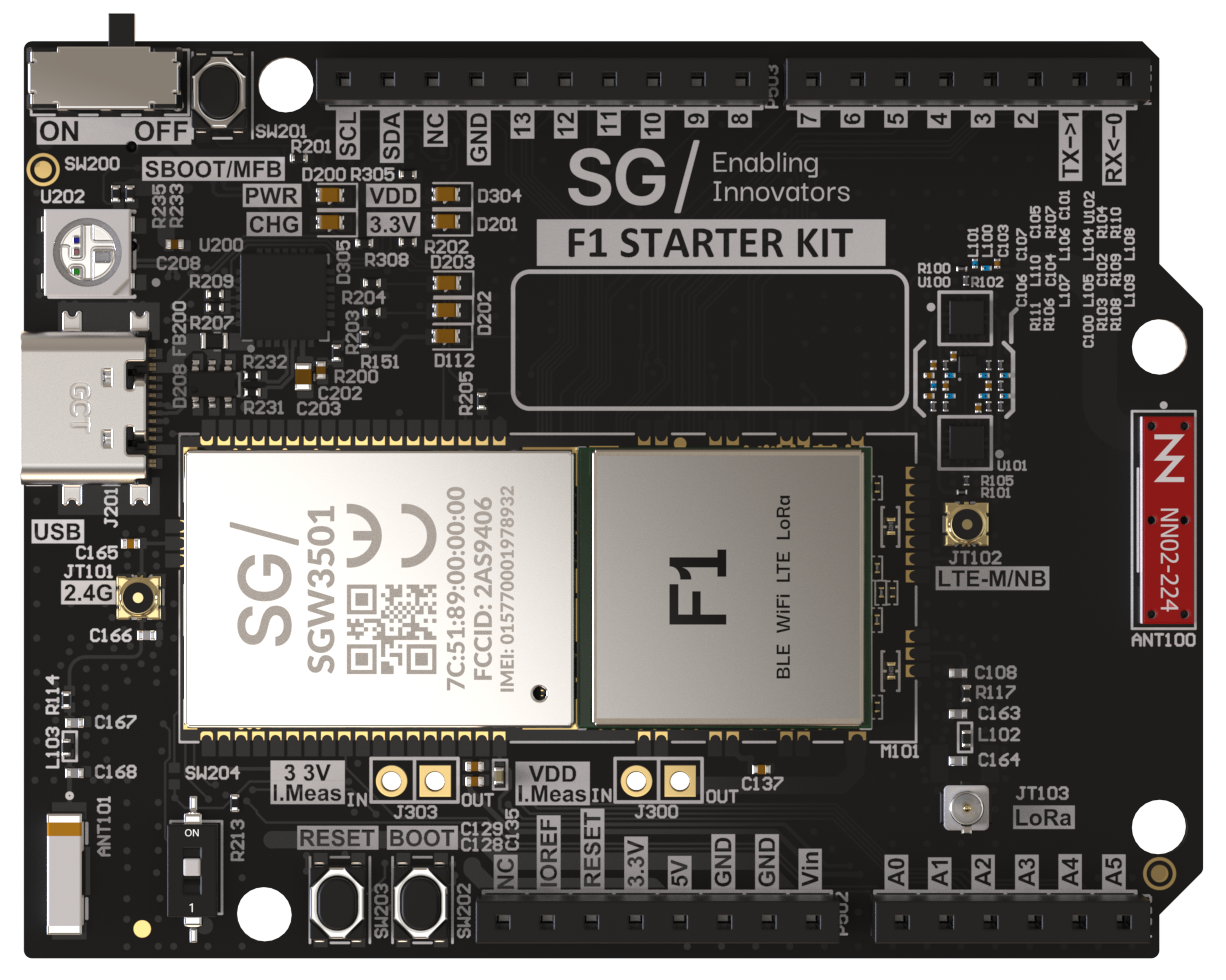
  • Top Device Port: Power, programming, and serial communication
  • Bottom OTG Port: External USB devices and peripheral interfaces
  • Simultaneous programming/debugging and USB peripheral connectivity for enhanced development flexibility
  • Top Device Port: Power, programming, and serial communication
  • Bottom OTG Port: External USB devices and peripheral interfaces
  • Simultaneous programming/debugging and USB peripheral connectivity for enhanced development flexibility

Bridging Prototype and Deployment

Yes, it’s a Starter Kit — but it’s built for more than getting started.

Combining Arduino-style development with production-ready IoT platforms,
the F1 Starter Kit takes you from prototype to deployment, without changing platforms.
If your goal is to… Developer Boards F1 Starter Kit Managed Production Platforms
Learn and Experiment Arduino, Raspberry Pi – strong community, simple tools, fast iteration Arduino-compatible hardware and MicroPython environment reduces development time with ready-to-use libraries Can be used, but typically overkill for early experimentation due to higher setup complexity
Test Prototype Connectivity Espressif Systems – good for testing individual connectivity options Multi-network options in one platform enables testing of real-world connectivity scenarios and fallback strategies Strong connectivity options across devices, but typically tied to specific architecture
Deploy with resilience Possible, but requires significant custom work (external modules, power optimization, network handling) Multiple protocols for reliable connectivity across changing network availability, with zero-touch provisioning for configuration in remote environments Built for deployment with integrated connectivity and infrastructure within a managed ecosystem
Manage IoT Fleets Not natively supported, requires building custom backend (MQTT, OTA, device management) Integration with existing cloud platforms through flexible data routing Native device management, OTA pipelines, analytics, and automation workflows built into the platform
Scale Industrial IoT Limited, requires redesign into production hardware and custom infrastructure One architecture supports multiple SKUs for deployments with varying connectivity needs Designed for large-scale deployments with full infrastructure, but may introduce dependency


What You Get in the Kit

  • Evaluation board with the F1 Smart Module
  • Global SIM card for 40+ countries, no carrier negotiations or data plan setup required
  • CAP/T Sensor for temperature and humidity data
  • USB cable, type A to type C
  • LoRa FPC antenna
  • Account on Ctrl Cloud Platform for device management, data visualization, and workflow automation
  • Technical documentation
  • 60min consultation with our team on starting your IoT project
  • Community of like-minded IoT enthusiasts

Core Processing

  • Core: F1 Smart Module (all 4 connectivity protocols)
  • Processor: Dual-core 240MHz Xtensa LX7
  • Memory: 8MB PSRAM, 16MB Flash

Connectivity and I/O

  • Interfaces: 2x UART, 2x SPI, 2x I2C
  • Expansion: Arduino UNO shield compatible
  • I/O Capabilities: Up to 6 analog inputs, Up to 14 digital I/O (all PWM configurable)
  • Qwiic connector included

.

.

Power Options

  • USB-C (5V) with OTG support
  • VIN (5V)
  • Li-Ion/Li-Po battery (3.7 – 4.2V)
  • Battery charging with fuel gauge

Onboard Features

  • Nano-SIM slot + Micro-SD slot
  • RGB LED (programmable)
  • 4x status LEDs (power, system, 3.3V, charging)
  • Boot, reset, and multi-function buttons

.

.

RF and Antennas

  • LoRa: IPEX connector (868/915MHz)
  • LTE: Onboard PCB antenna with regional band switching
  • Wi-Fi/BLE: Onboard ceramic chip antenna

Real-world Use Cases

Be inspired – practical applications enabled by the F1 Starter Kit’s flexibility and performance.


Industrial Monitoring

Wi-Fi bridge, cellular backup

  • Connect legacy industrial equipment to modern IoT platforms using Wi-Fi for primary connectivity and cellular as automatic failover.
  • Monitor vibration sensors, temperature probes, or pressure gauges with real-time alerts via Cloud notifications.
  • Arduino shield compatibility allows interfacing with existing PLCs and industrial sensors without custom PCB development.

Asset Tracking

Multi-network redundancy, global connectivity

  • Track high-value assets across different environments: Wi-Fi/BLE for indoor positioning, cellular for wide-area tracking, and LoRaWAN for power-constrained scenarios.
  • Included global SIM works across 40+ countries without roaming fees or carrier switches.
  • Ideal for construction equipment, shipping containers, or fleet management where connectivity requirements change based on location.

Smart Agriculture

LTE for remote monitoring, LoRa for sensor networks

  • Deploy soil moisture sensors using LoRaWAN for low-power, long-range communication, while cellular LTE provides real-time data uploads and alert notifications to your dashboard.
  • Battery life extends for months with deep sleep mode, and global SIM eliminates carrier negotiations for rural deployments.
  • Ideal for precision farming, livestock tracking, or greenhouse automation where Wi-Fi isn’t available.

Prototyping

Rapid testing across different connectivity scenarios

  • Validate your IoT concept across multiple network types without ordering different development boards.
  • Test power consumption profiles, connectivity reliability, and data throughput for each protocol using the same hardware platform.
  • MicroPython environment lets you switch between connectivity modes with simple code changes, accelerating proof-of-concept development and client demonstrations.

This website uses cookies

We use cookies to improve your experience and to provide us with insight into how people use our website

To find out more, read our cookies policy