Your basket is currently empty!
Prototyping Serverless Wi-Fi Location Tracking with the F1 Starter Kit

We teamed up with IoT Stars to explore Wi-Fi-based location tracking using the F1 Smart Module’s built-in connectivity.
Knowing where an asset is can help businesses monitor equipment and improve visibility across their operations. But there’s no one-size-fits-all approach to location tracking: GNSS only works reliably outdoors, while Wi-Fi-based positioning depends on the availability of known access points and the accuracy an application needs.
For product developers, the trick is finding out what works before committing to custom hardware. That means experimenting with different connectivity options, testing them in practice and validating the concept without building a new board for every idea.
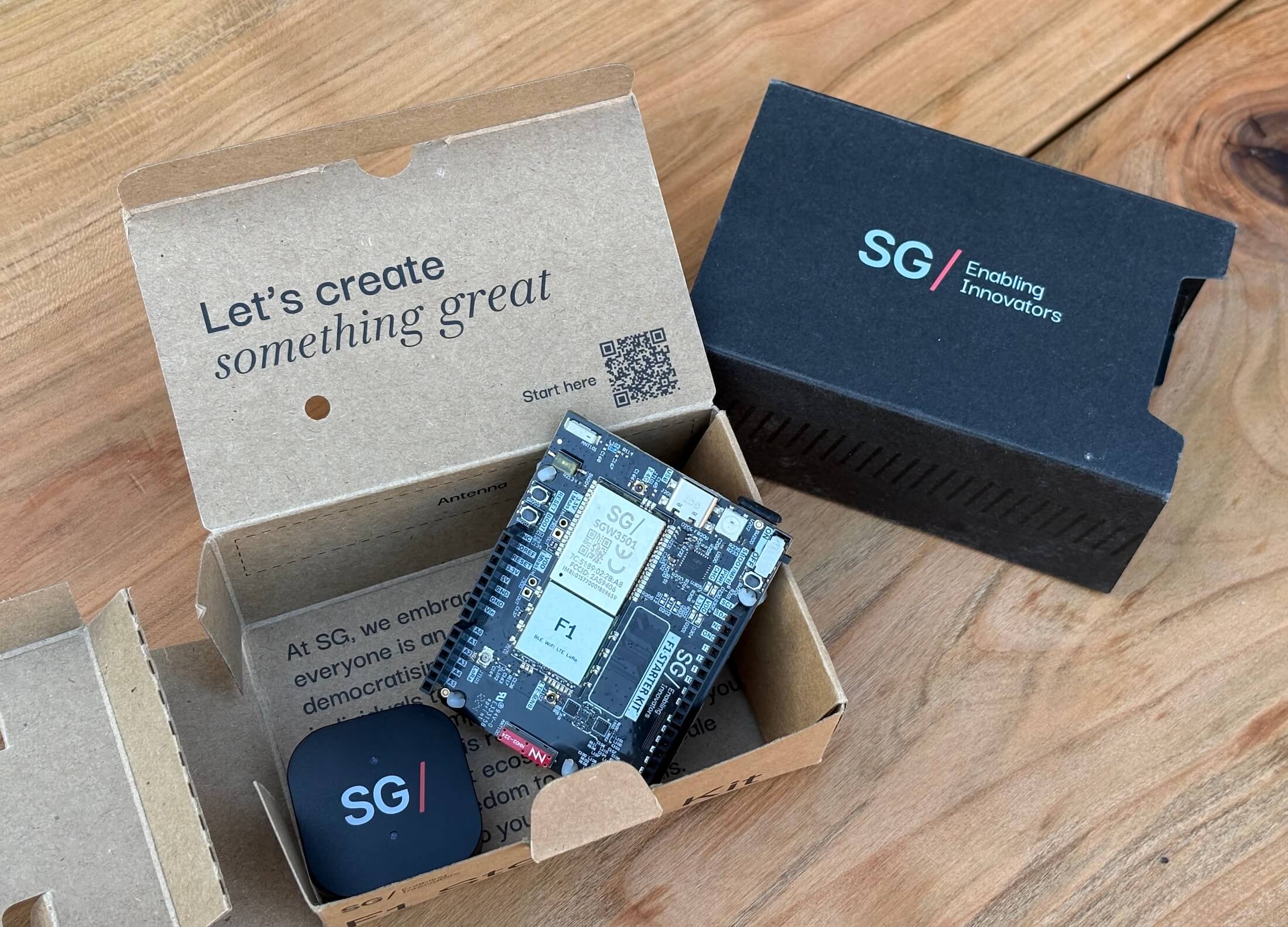
Enter the F1 Starter Kit. With multiple wireless technologies already built-in, surely it’ll be up to the challenge. We teamed up with Laurens Slats from IoT Stars to put it to the test, building a Wi-Fi-based tracking demo that combines Wi-Fi scanning with cellular connectivity.
Why Wi-Fi positioning?
Wi-Fi positioning is already widely used in commercial asset-tracking solutions where approximate location information is enough, particularly in environments where satellite positioning may be unreliable or unnecessary. Think mobile equipment, returnable assets or connected devices out in the field.
The other half of the solution is getting the location data where it needs to go. Pairing Wi-Fi scanning with cellular connectivity lets a device send collected data to an external service for processing, making the combination worth exploring for connected tracking applications.
Why the F1 Starter Kit?
The F1 Starter Kit is the evaluation board for the F1 Smart Module, which brings together Wi-Fi, Bluetooth Low Energy (BLE), LoRaWAN and cellular connectivity (LTE-M and NB-IoT) in one programmable platform.
The built-in connectivity means developers can experiment with Wi-Fi scanning and cellular data transmission using the connectivity already on board, rather than designing custom hardware.
And if the application calls for a different approach, the same platform lets developers explore alternatives, such as BLE for proximity-based detection or LoRaWAN where suitable network coverage is available.
Putting it together
So, how do you turn Wi-Fi signals into a location estimate? Laurens put the F1 Starter Kit to work scanning nearby Wi-Fi access points, then sending the collected data over cellular connectivity to a service that estimates the device’s position.
The results?
It works, better than I expected.Laurens Slats, IoT Stars
The existing tools let the device run by itself, without me having to run any servers with impressive accuracy.

Want to dive into his set-up? Watch the hands-on demonstration here:
Need more? Check out his blog for full details.
The interesting part is that you don’t need Laurens’ exact same set-up to recreate this. The F1 Starter Kit already comes with a 1NCE SIM card for cellular connectivity, and Wireless Logic also supports the Kit on its platform.
From prototype to application
Getting a demo up and running is a great start. The next step is seeing how it holds up in the real world: Is there enough Wi-Fi coverage to produce useful location estimates? Is the accuracy good enough? How will power consumption and connectivity hold up?
Testing under realistic conditions helps developers answer these questions, refine the design and build confidence before committing to production hardware.
And once the concept is validated, we’ve arrived at the path to production — with a whole new set of challenges. Luckily, we may have an answer for that too. Stay tuned.
Conclusion
If you take away one thing in the meantime, it’s this: You don’t need to have every hardware decision figured out before you start experimenting. Test the idea, see what the results tell you, and let the application guide what comes next.
SG Wireless designs and engineers IoT solutions that move beyond the prototype, as the IoT-specialized design engineering subsidiary of Season Group.
IoT Stars is a community of IoT professionals who meet at the world’s leading tech events to connect, share, and learn.